AI pricing · 31 July 2026 · Asfandyar Malik
OpenAI Cut the Price 80%. Where Does the Saving Disappear?
5 chapters, played or read
Runtime 03:45
Overview
The one idea
cd youtube-videos/07-openai-80-percent-cut/experiments
./invoice-test.sh --show-basket
00:0003:45
the headline, and the question under it
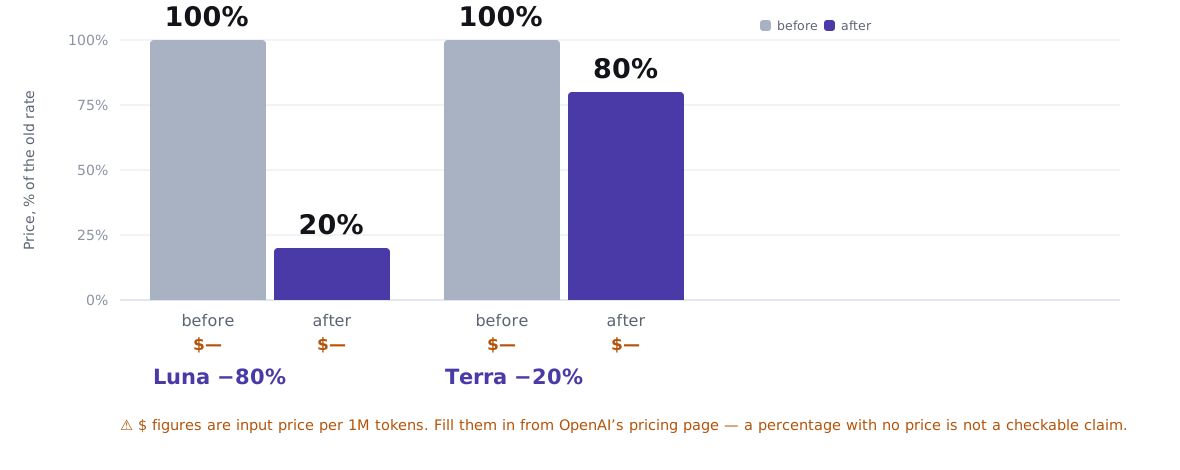
"OpenAI just cut the price of GPT-5.6 Luna by eighty percent. Terra by twenty. And Greg Brockman described it as 'intelligence too cheap to meter.'
That's a real cut and it's an enormous one — I want to be clear about that before I complicate anything. Eighty percent is not a rounding.
But 'the price went down eighty percent' and 'your bill goes down eighty percent' are two completely different sentences, and there are three specific places the second one leaks before it reaches you. One of them is in OpenAI's own announcement, in a sentence almost nobody read twice.
what actually shipped, and it's genuinely good
"So first, precisely what was announced, because it's three separate things and they got flattened into one headline.
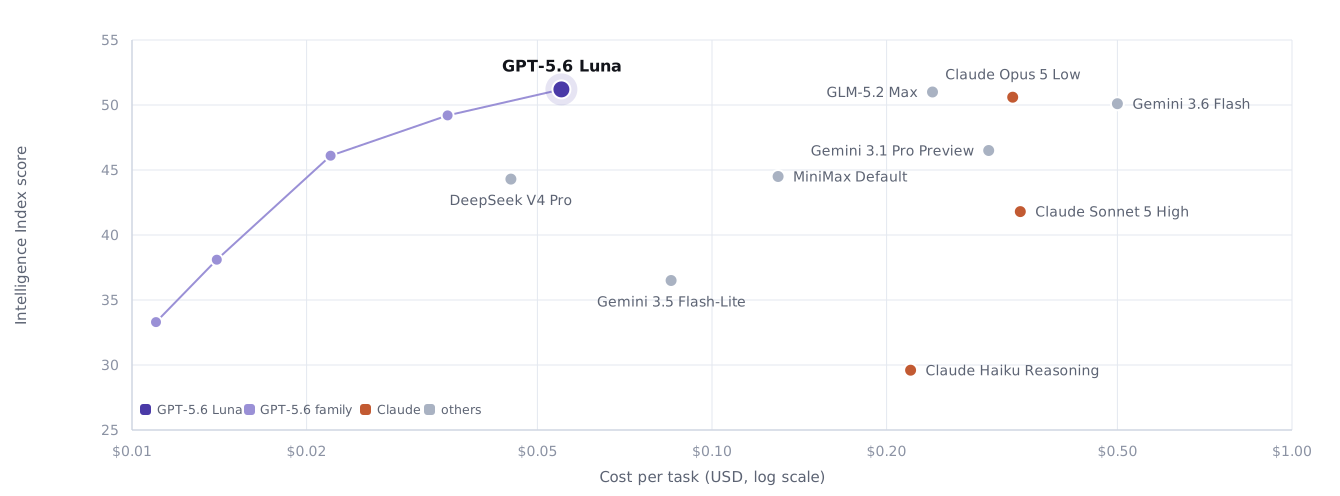
They published this alongside it. And I want to be careful about how I read it, because it's a specific kind of object: the benchmark is third-party — Artificial Analysis — but the chart is OpenAI's. They chose the comparison models, they chose the axes, and they wrote the subtitle. Read the subtitle: 'GPT-5.6 Luna achieves the highest intelligence score at a fraction of the cost of similarly capable models.' That's not a description of data. That's a claim about who won.
[Optional 20s, if video 06 has shipped — :] Small aside, and it's funny. Within about a day, that same chart was going round with the subtitle swapped for a neutral one and a DeepSeek dot drawn onto it that isn't on OpenAI's version. One chart, two companies' marketing, and tens of thousands of people reading it as neutral data. I did a whole video on that.
Right. Eighty percent. Where does it go."
the three disappearances. THIS IS THE VIDEO.
"Disappearance one: they cut the rate, not the bill.
Your bill is the rate times the tokens. They changed one of those two numbers. If your token count next month is what it was last month, then yes — you'll see most of that eighty percent. But your token count is not a constant, it's a consequence of how you work.
I made a whole video about this with Claude: a model at half the rate that used three times the tokens produced the same invoice. Same principle here, and it's just arithmetic.
Disappearance two: cheap models get pointed at bigger jobs.
This is the one nobody plans for. When a model costs a fifth of what it did, you don't run the same workload and pocket the difference. You raise the effort setting. You stop trimming the context. You send it the whole file instead of the function. You start using it for things that weren't worth it before.
Disappearance three — and this is the one I actually made the video for.
Here's a sentence from the announcement: 'Luna and Terra's lower prices are reflected in how usage is counted in Codex and ChatGPT Work, so your usage goes further.'
Read that again.
In Codex and in ChatGPT Work, you don't pay per token. You have an allowance and you spend it. So in those two products this is not a price cut at all — it's a change to how your usage gets counted against your quota.
And the announcement doesn't say by how much. 'Your usage goes further' is a direction. It isn't a number.
Eighty percent is real at the top of that funnel. What reaches your invoice is an empirical question."
"too cheap to meter"
"Which brings me to the phrase, because it wasn't chosen at random.
Seventy years later, I still get an electricity bill.
Cheaper units, more units, same-ish bill. That's disappearance one and two, with seventy years of receipts.
So I'd take the phrase as a prediction rather than a slogan. And predictions can be checked. There's exactly one place to check this one."
measure the only number that matters
"Your invoice. But not cost per token — cost per finished piece of work.
Here's the thing cost-per-token hides: a cheap tier that fails and needs a second attempt is not cheap. Eighty percent off a model that takes three goes at your task is not a saving, it's a worse deal with a better sticker.
So: a fixed basket of small, checkable tasks. Same basket to each tier. Scored pass or fail against a known answer — not vibes. And then one number: what did one completed task cost me.
One: this does not measure the before. The cut already happened — I can't go back and run it at the old price. So this isn't a before-and-after of the price cut. It's 'what does a unit of finished work cost me right now, on each tier.' Which is the decision you're actually making.
Close + CTA
"So — is this a good thing? Yes. Unambiguously. An eighty percent cut is one of the biggest price moves anybody has made, the chart they published is impressive, and cheaper intelligence is good for everyone watching this.
Will your bill drop eighty percent? Almost certainly not — and now you know the three reasons, and which of them you can actually do something about.
Next time a price cut lands, the question isn't 'how big is the number.' It's 'which of my costs does it touch, and what does a finished task cost me after it.' That takes ten minutes to measure and it's the only version of the question that pays.
The basket script is in the description, free, go and run it on your own workload. And if you want the whole setup — which jobs go to which tier and how to wire it — that's what we do inside Claude Codex Mastery, nine dollars a month, going to twenty-nine. Link's below. See you in the next one."
🧪 The experiment — Level 4 is the runbook
experiments/EXPERIMENT.md is the step-by-step.
| Step | Command | When |
|---|
One basket of checkable tasks. Every tier. Scored pass/fail. Reported as cost per completed task.
The one idea
A cheap tier that fails and needs a second attempt is not cheap.
Cost-per-token flatters exactly the tier you're being tempted by. Cost per completed task doesn't, because a failed run still costs money and delivers nothing. That metric survives both a price cut and a change in how you work — which is precisely what disappearances one and two do to you.
⚠️ What it cannot do
It cannot measure the "before". The cut already happened; there's no way back to the old rate.
So this is not a before-and-after of the price cut. It is "what does a unit of finished work cost me right now, on each tier." Which is the decision you're actually making — but if you don't say so, a viewer will reasonably think you measured something you didn't.
The five steps
1 · Read the basket (free)
cd youtube-videos/07-openai-80-percent-cut/experiments
./invoice-test.sh --show-basketThe mix is deliberately uneven: some are trivial, some need real multi-step reasoning. A tier that aces the easy ones and drops the rest is exactly the result this exists to surface.
Swap them for tasks that look like your work. That's the point. Keep the shape: one checkable answer, a stated output format, and
accept/rejectlists.
2 · 🔴 Fill in the prices — this is the gating job
Open invoice-test.sh and look at TIERS. Three of the four rows say ?:
Luna|openai|gpt-5.6-luna|?|?
Terra|openai|gpt-5.6-terra|?|?
Sol|openai|gpt-5.6-sol|?|?
Claude|anthropic|claude-opus-5|5.00|25.00
Get them from the vendors' own pages:
3 · Dry-run (free)
./invoice-test.sh --dry-runPrints the plan — 4 tiers × 8 tasks = 32 calls — and calls nothing. Tasks are deliberately tiny, so the bill is dominated by per-call overhead rather than prompt size.
4 · Run it
export OPENAI_API_KEY=...      # never commit these
export ANTHROPIC_API_KEY=...
./invoice-test.sh
5 · Read the detail before you believe the table
cat out/luna/t07/score.json | jq
./invoice-test.sh --report
Not optional. Two things to check by eye:
- A wrong answer vs a wrong format. The grader tolerates fences, preambles and a missing
ANSWER:prefix, but it is still a matcher. If a tier got the right answer in a shape the matcher missed, you should know that rather than report it as a reasoning failure.
Then type the numbers into slide 15 of ../slides-youtube.html — it ships with — placeholders and an empty chart. Replace every one.
Rules
out/is gitignored. Don't commit run artefacts.- No client data, client names or internal docs in the basket. The shipped tasks are synthetic; keep yours that way too.
- n=1 per task per tier, one basket, one account. Directional, not a benchmark.
Files
| File | What it does |
|---|---|
invoice-test.sh | The runner. bash 3.2 (macOS default) — no declare -A, no mapfile |
basket.json | The eight tasks, with accept / reject lists |
score-task.py | Grades one answer. Lenient on form, strict on content |
What was tested before this shipped
Against a stubbed curl, so no real spend:
- ✅ Both provider response shapes parsed (Anthropic
content[], OpenAIchoices[]) - ✅ Cost arithmetic verified by hand (720 in / 96 out at $5/$25 → $0.0060; ÷7 passed → $0.0009)
- ✅ API failure reports in its own
ERRcolumn and never as a wrong answer - ✅ Zero-passes doesn't divide by zero — reports
n/a (0 passed) - ✅ Unpriced tiers report
$? (unpriced)rather than inventing a cost - ✅ 13 grading cases: prefixed, unprefixed, fenced, verbose-but-correct, wrong, empty, missing file, both cron variants, and the "names both options" case that
rejectmust catch - ✅ Unknown task id exits 2 with a message
- ✅
--reportreplays a finished run without calling anything - ✅
--show-basketprints every task and its expected answer - ✅
bash -nclean, no bash-4-only syntax - ✅ The three computed answers in the basket (57 hours, 4 overlaps, 3 minutes) were re-derived independently before shipping
Screenshots, charts, and primary evidence.
Open any evidence visual full-size. This library contains real screenshots and project charts—no decorative generated artwork.

Keep exploring
More long-form resources built the same way — primary sources, working files, and commands that actually run.
Setup instructions rot faster than anything else here. Every command on this page is copied from the vendor's own documentation and linked to it — open the docs alongside this page and trust those over this one.